 Veranda
 Gemini
Veranda Gemini is a browser for Gemini, a small protocol for small, text-based pages ("capsules"). It can also show web pages turned into text, PNG pictures, and Wikipedia. It works through the Wi-Fi modem and needs Zimodem with ATCS (see Network setup).
Start it
- Double-click Veranda Gemini in
/VERANDA/APPS. It starts on the bookmarks page. - Double-click Wikipedia in
/VERANDA/APPS(a W on a globe): Veranda Gemini starts and asks "Look up in Wikipedia:".
Browse
- The address line: type an address such as
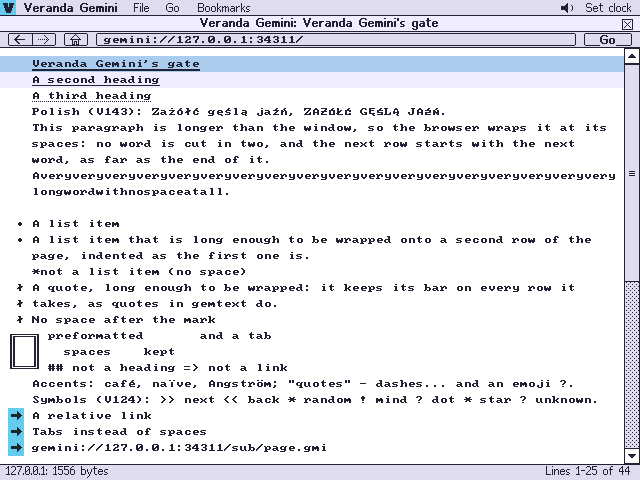
gemini://geminiprotocol.net/docs/, or just a host name. Press Return or click Go. Click the line, press Ctrl+L, or start typing. Ctrl+V pastes. Esc leaves the line. - Pages: headings are underlined, list items have a bullet, quotes a bar. Preformatted text keeps its columns (a line wider than the window is cut). Paragraphs wrap to the window.
- Links have a badge: an arrow (cyan) for Gemini, a globe for the web, a folder (yellow) for Gopher, an envelope (purple) for mail, a picture (orange) for an image, grey for anything else.
- Click a link to follow it (Shift+click only selects it). Or press Tab (Shift+Tab back) to move from link to link and Return to follow.
- Questions: a capsule may ask for text (a search). A box asks you. Do not type secrets: the box shows what you type, and see Security below.
- Redirects are followed (5 at most). A redirect to another host asks first.
- Plain text pages are shown wrapped. Other files ask whether to download them to
/DOCUMENTS. File > Download downloads the selected link (or the page) without asking. Stop (or Esc) stops. - Back and Forward (the toolbar, the Go menu, Left and Right, Backspace): the last 14 pages. The last three come back at once from memory. Reload: Ctrl+R. Home: the bookmarks page.
- Find (File > Find..., Ctrl+F) finds a word in the page; Find again (Ctrl+G) the next one. A word wrapped across two rows is not found.
- Scrolling: the wheel, Up, Down, PgUp, PgDn, Home, End, or the scroll bar at the right: its arrows move a row (hold one down to keep going), a click on the track above or below the thumb moves a page, and the thumb can be dragged.
- The menus show each command's key at the right. The box at the right of the title bar quits, as Veranda Gemini > Quit (Ctrl+Q) does.
A Gopher or mail link only shows where it leads (Veranda Gopher opens Gopher addresses).
Bookmarks
Bookmarks > Add this page adds the page (named by its first heading). Remove... removes the bookmark selected (with Tab) on the bookmarks page. Up to 16.
Without your own bookmarks file, Veranda Gemini starts with: Project Gemini, the Kennedy search engine, geminispace.info's search, the Antenna feed, gemi.dev, NewsWaffle, Gemipedia and Gemipedia's featured articles. (The first four were written from memory and not checked.)
Your bookmarks are in /VERANDA/.SYSTEM/GEMINI.MARKS, one link per line:
=> gemini://geminiprotocol.net/ Project GeminiThe package never replaces this file. If you have one from before, add these lines by hand to get the new services:
=> gemini://gemi.dev/ gemi.dev
=> gemini://gemi.dev/cgi-bin/waffle.cgi NewsWaffle: web pages as gemtext
=> gemini://gemi.dev/cgi-bin/wp.cgi/ Gemipedia: Wikipedia
=> gemini://gemi.dev/cgi-bin/wp.cgi/featured Wikipedia: featured articles
Web pages
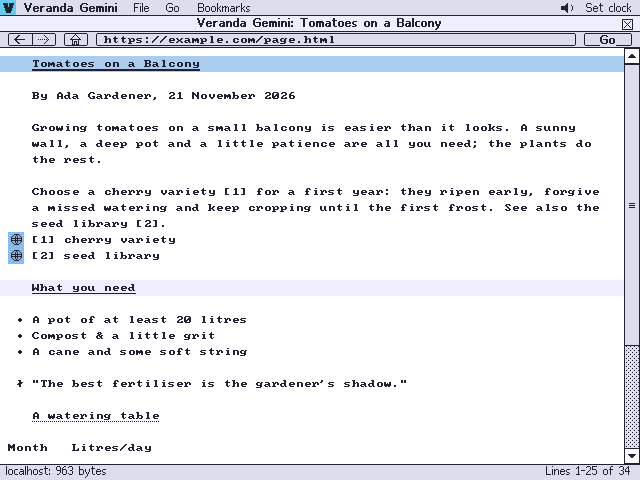
The X16 has no web browser, but Veranda Gemini can show ordinary web pages as text: their text, headings, lists and links. Follow an http:// or https:// link, or type such an address. A box asks:
- Yes: through NewsWaffle, a free public service at gemi.dev. It fetches the page and sends it back as gemtext. It is best for articles and news. It sees every page you read through it, and it may be slow, change or go away.
- No: through your own proxy on a PC (below).
- Cancel: neither.
Your own proxy: web_proxy.py
- Copy
PC/web_proxy.pyfrom the card to a PC on your network (Python 3, nothing to install). - Run
python3 web_proxy.py. The first time it makes a certificate withopenssl(or says how). It listens on port 1965 and takes requests only from home-network addresses. - In Veranda Gemini: File > Settings..., answer 2 (always my proxy) or 0 (ask), then type the PC's address, for example
192.168.1.20(port 1965 if you give none).
The proxy keeps a page's article text, headings, lists and links (the links numbered after each paragraph), and cuts a page at 64 KB. Its own pages: gemini://<the PC>/ (a start page), /search (a search through DuckDuckGo), /go (asks for an address). Other Gemini proxies with TLS, such as Duckling proxy or levior, work too.
File > Settings...
Four boxes, one after another (leave one empty to keep it):
- Web pages: 0 ask each time (the default), 1 always NewsWaffle, 2 always my proxy, 3 never.
- Your proxy's
host:port. - The largest picture shown without asking, in KB (256 at first).
- Wikipedia's language:
en(the default),pl,de,fr,simple...
They are kept in /VERANDA/.SYSTEM/GEMINI.CFG.
Pictures
A link to a picture has [Show image] after it. Click it (or Tab to it and press Return, then Yes to show, No to save). A PNG or JPEG picture is shown in the window in 16 colours, scaled to fit. Save (or S) copies the picture to /DOCUMENTS. Anything else goes back to the page: Esc, Backspace, Back, a click on the picture or the wheel. Another key, a toolbar button or a menu goes back to the page and then does its job, and the close box, Quit or Ctrl+Q quit straight away. While a picture is still being drawn its menus are off.
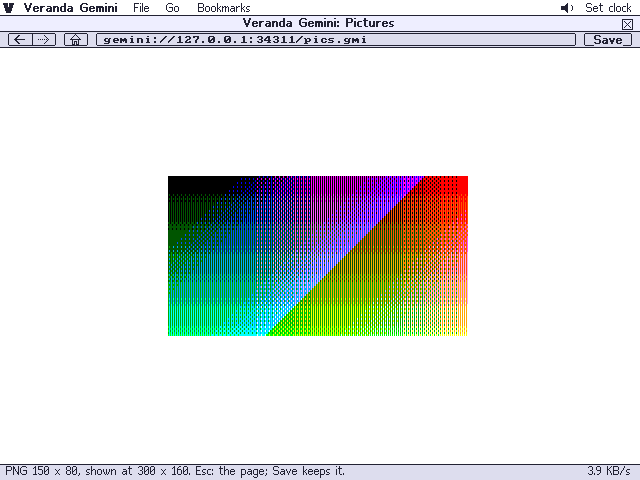
- Pictures with a palette of 16 colours or fewer keep their colours. Grey pictures get 16 greys. Photographs look posterised.
- A large picture takes time: a 740 x 300 PNG about 30 seconds, a Wikipedia photograph (a JPEG of about 440 x 290) about 11 seconds on an X16 whose VERA has FX (firmware 0.3.1 or later), about 19 seconds on an older one.
- Not shown (save them instead): progressive JPEG, GIF, BMP, interlaced PNG, very wide pictures. With Pillow on the PC (
pip install pillow),web_proxy.pyturns them into PNG for you.
Wikipedia
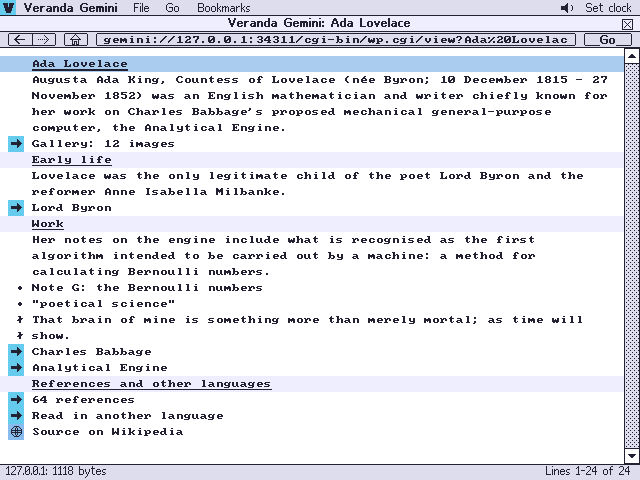
Veranda Gemini reads Wikipedia through Gemipedia, a free public Gemini front end to Wikipedia at gemi.dev.
- Go > Wikipedia... (Ctrl+W) asks "Look up in Wikipedia:". Type a title (it need not be exact) and press Return. Without an article of that name, you get Gemipedia's search.
- In the address line,
wp Ada Lovelace(orw Ada Lovelace) looks it up.wpalone asks. - The language is set in File > Settings... (the fourth box).
Gemipedia sees what you look up. It may be slow, change or go away.
Security
Gemini always uses TLS. The modem makes the connection (ATCS) and does not check the capsule's certificate, and Gemini's usual "trust on first use" is not possible either. Someone on your network could pose as a capsule. Do not type anything secret into a capsule's questions. Client certificates are not supported.
Limits
- A page keeps 32 KB. A longer one is cut ("Cut here"); File > Download saves all of it.
- An address is 255 characters at most. No IPv6 addresses, no international names.
- Text is shown in the X16's character set: accented letters it has, common emoji and symbols as short ASCII (
>>,*), others as?.
Alt+Tab puts Veranda Gemini aside, even during a download.
This page is also in the wiki, and on the X16 (the desktop's Veranda > Help).